Welcome to the route presentation for the 2026 edition of cycling's greatest race! This year's race opens with a spectacular Grand Départ on the island of Corsica before threading through Provence, the Pyrenees, Brittany, and ultimately delivering a punishing Alpine finale. It is a route that rewards the all-rounder above all else.
If you were from an alternative dimension you could get a deja vu as many of the stages were there raced in 2013, with some 2023 in the mix. When looking at the alternative dimension Chris Froome is supposed the be the winner... Considering that Froome was a quite good puncheur that sounds quite unlikely, even with a 80+ hill stat having just around 70 in climbing is not enough to win TDF... With that we can conclude that this version of reality is pretty far fetched, everyone knows that the real winner in 2013 was Angel Madrazo which feels much more likely as he was a great GC rider
Week 1
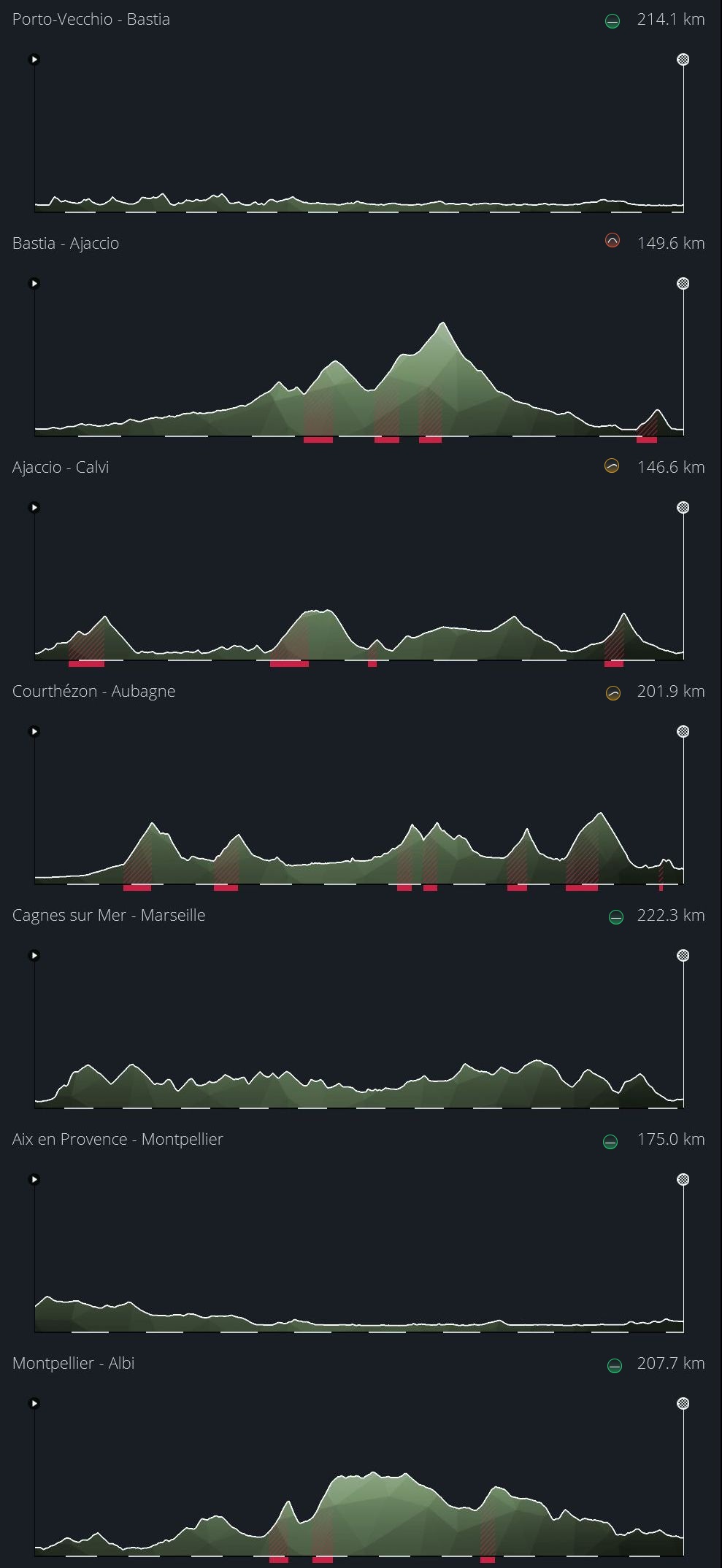
The Tour begins on the Île de Beauté, and what a beginning it is. Stage 1 takes the peloton from Porto-Vecchio all the way north to Bastia across 214 kilometres of largely coastal roads. The profile is flat enough that the sprinters will feel confident — though anyone who has raced Corsican roads knows that a flat profile rarely tells the full story. Expect echelons, nervous racing, and a hard-fought bunch sprint. This is the chance for a lot of riders to get a day in yellow!
Day two is a different beast entirely. Bastia to Ajaccio crosses the mountainous spine of Corsica, and the profile is brutal — multiple significant passes stacked on top of each other before a finale in the island's capital. This is an early and emphatic statement of intent for the GC men, and we could easily see the first real gaps at just 149.6 kilometres. Here is a chance for both the GC guys to take yellow, but also other climbers or puncheurs to grab those extra points
Stage 3 rounds out the Corsican opening with a hilly ride from Ajaccio to Calvi. The climbs come early and the run-in is more forgiving, making this one for a select breakaway or a punchy rider who survived the previous day intact.
After the transfer to the mainland, Stage 4 brings us into the sun-baked landscapes of Provence on a 201.9-kilometre hilly trek from Courthézon to Aubagne. Several sharp climbs dot the route, and the late hills before Aubagne could see the GC contenders testing each other again — it is the kind of stage where a dangerous secondary GC man could slip away.
Stage 5 is a coast-hugging monster at 222.3 kilometres from Cagnes sur Mer to Marseille. The route is largely flat, giving the sprinters their best opportunity since stage 1. After the exertions of the previous days, expect a reduced bunch — but also expect fireworks at the line.
The following two stages keep the race rolling westwards. Stage 6 from Aix en Provence to Montpellier (175 km) is flat and fast, a chance for the sprinters to stock up on points and confidence before the Pyrenees arrive. Stage 7 continues to Albi over 207.7 kilometres — the profile shows some lumps in the middle third, enough to split things if the wind gets up across the Languedoc plateau, but ultimately another opportunity for the fast men.
Week 2
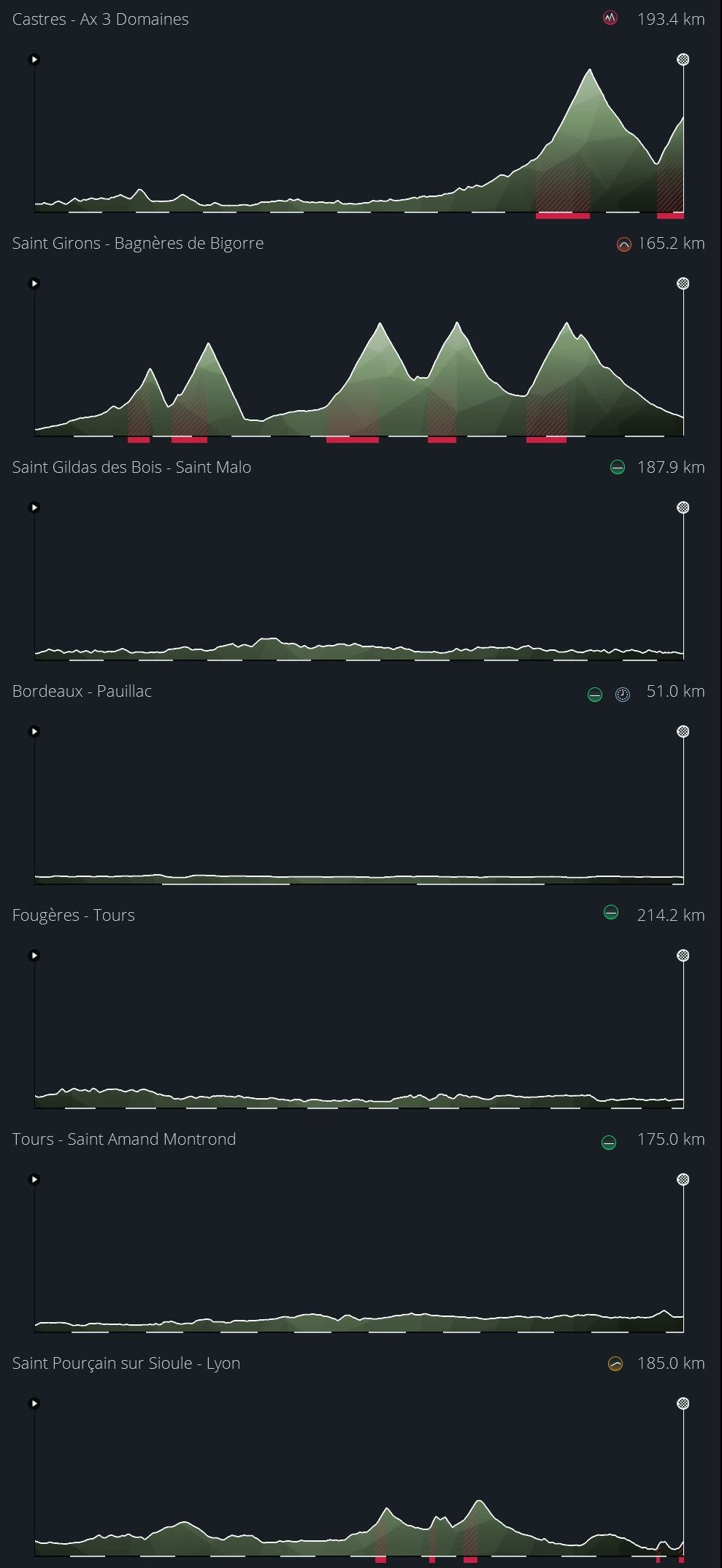
The mountains arrive emphatically on Stage 8. Castres to Ax 3 Domaines is 193.4 kilometres with a long, flat run-in followed by an enormous final ascent to the summit ski station. Ax 3 Domaines has a rich Tour history — it was here that Lance Armstrong memorably cracked in 2003 — and it will once again be the scene of a pivotal GC battle. Whoever crosses the line first will almost certainly be wearing yellow by evening.
Stage 9 from Saint Girons to Bagnères de Bigorre doubles down on the Pyrenean suffering. At 165.2 kilometres it packs in multiple major cols before the summit finish, making this potentially the hardest day of the race's first half. The GC picture could look dramatically different by the time the race reaches Bagnères.
And then — relief. The race heads north to Brittany for three stages that will feel like a holiday after the mountains. Stage 10 from Saint Gildas des Bois to Saint Malo is almost perfectly flat at 187.9 kilometres across the Breton countryside. The sprinters will be licking their lips.
Stage 11 is a standalone time trial: just 51 kilometres from Bordeaux to Pauillac along the flat roads of the Médoc wine country. Short by Grand Tour standards, but on a good day a specialist could put a minute or more into the pure climbers. It could well reshuffle the top ten considerably.
Stages 12 and 13 then trace a gentle arc through the Loire Valley. Fougères to Tours (214.2 km) and Tours to Saint Amand Montrond (175 km) are both flat to gently rolling — the sort of stages where domestiques do their work and breakaway artists dream of glory.
The week closes with Stage 14 from Saint Pourçain sur Sioule to Lyon, a hilly 185-kilometre stage that serves as a gentle reminder to the peloton that the Alps are just around the corner. The climbs are not enormous, but the punchy finishers will be alert to the opportunity. We saw this exact route in the 2023 edition and it was then won by a breakaway with Hamza Mansouri taking the win
Week 3
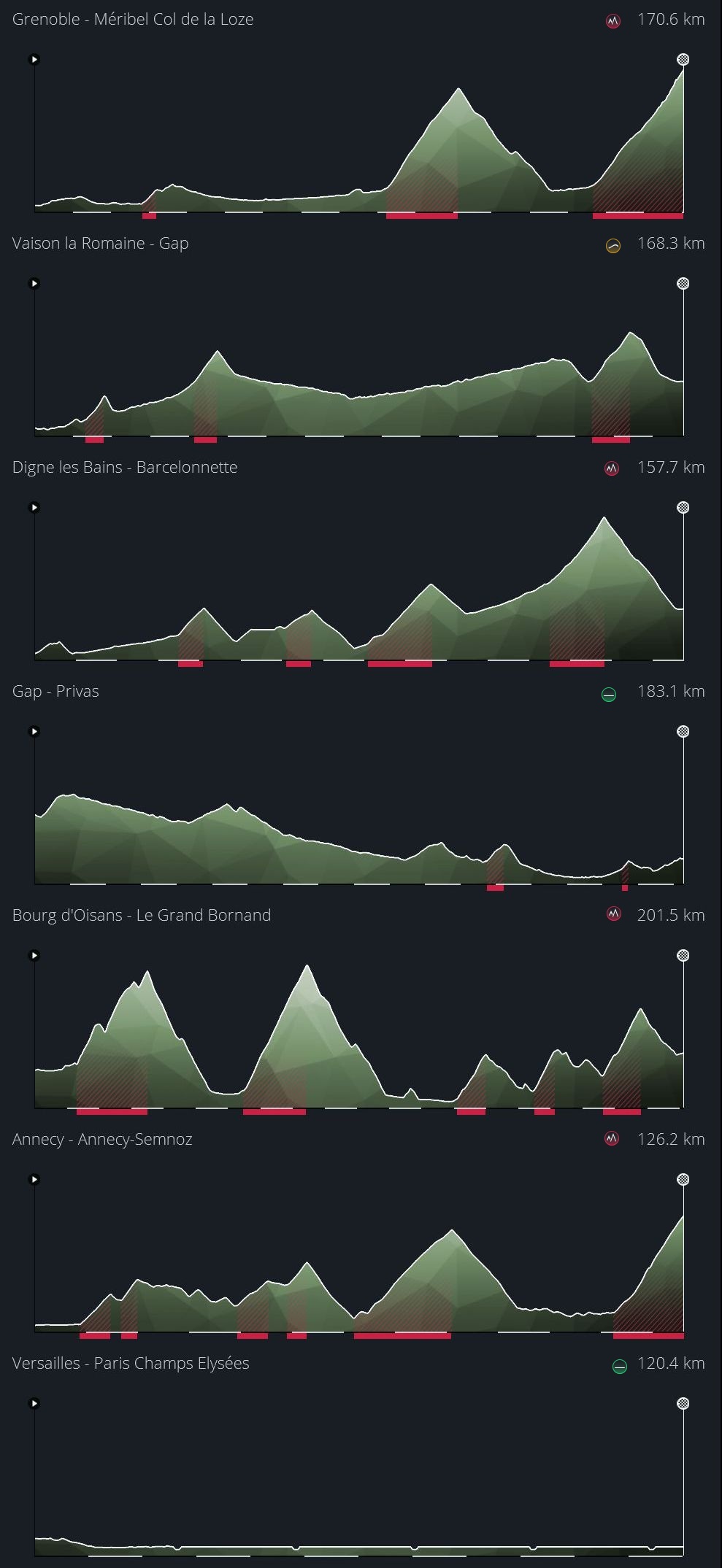
The race's decisive week opens with perhaps its most fearsome stage. Grenoble to Méribel Col de la Loze: 170.6 kilometres that end at one of the highest and steepest summit finishes in the modern Tour's repertoire. Col de la Loze sits at over 2300 metres and features sustained ramps that make it virtually impossible to hide a weakness. This will be a landmark stage.
Stage 16 offers slightly more breathing room — Vaison la Romaine to Gap over 168.3 kilometres, with consistent Alpine climbing throughout but a more traditional finish in the riders' town of Gap. A hilly day, not a rest day, but perhaps the last chance for the GC outsiders to recover before the final push. This is another stage we also saw in 2023, that time we saw a sprint from a reduced peleton and a win for Eduard Grosu
Stage 17, Digne les Bains to Barcelonnette, is another summit finish at 157.7 kilometres. The profile shows a punishing final climb and could be a launchpad for last-minute GC attacks from anyone who fancies their chances in the mountains.
Stage 18 from Gap to Privas is the race's transitional stage, beginning high and descending into the Ardèche over 183.1 kilometres. For the climbers it is a day to recover; for the sprinters and classics men, a day to try their luck with the right move.
Then come two consecutive summit finishes to blow the race wide open. Stage 19 from Bourg d'Oisans to Le Grand Bornand is a monstrous 201.5-kilometre Alpine odyssey. Starting at the foot of Alpe d'Huez without going up it, the stage instead piles three enormous climbs onto the peloton before the ski station finish above Bornand. This is a stage where legends are made. When we saw this exact route in 2023 the 2 frenchies Lecuisinier and Barguil fought for the vicotry with Lecuisinier winning in the end
Stage 20, Annecy to Annecy-Semnoz at 126.2 kilometres, is the last and arguably cruelest mountain test. The short distance masks the ferocity — several climbs precede the summit finish on the Semnoz, and with the maillot jaune on the line, expect every GC contender still standing to empty the tank completely. Another mountain stage we saw in 2023, then with Warchol taking the stage win and securing the climbers jersey.
And so to Paris. Stage 21 rolls 120.4 kilometres from Versailles to the Champs Elysées in the traditional fashion — a day of ceremony, champagne, and an inevitable sprint finale under the Arc de Triomphe.
Summary
Overall we have a Tour for the complete climber this year, with enough time trialling to unsettle the pure mountain men and enough Pyrenean and Alpine summit finishes to leave the pure rouleurs dreaming. The Corsican opening is a spectacular novelty that will inject unpredictability from the very first kilometre, and the back-to-back Alpine summit finishes in week three could deliver one of the most dramatic finales in recent Tour history. Key stats below:
7 Flat stages
6 Hilly stages
7 Mountain stages
1 ITT (51 km)
Not sure there is a real hard stage here across all the 3 weeks. On paper not the Grand Tour for us, but our best GT last year came from sending a weak squad so you never really know in this game.
More time trialing than the other two, but given that the TT will precede all of the breakaway antics in the final week, it likely won't be too consequential for the final standings anyway. Gives us a lot to think about!
RIP Exxon Duke, David Veilleux, Double Feature, and Monster Energy