Welcome to the route presentation of the Giro d'Italia, the first Grand Tour of the year and always a stunner. This edition is no different - I'd love to summarise it for you right now, but you should probably just see for yourself. What a race we have coming this April!
Week One: Sprints and sea breezes
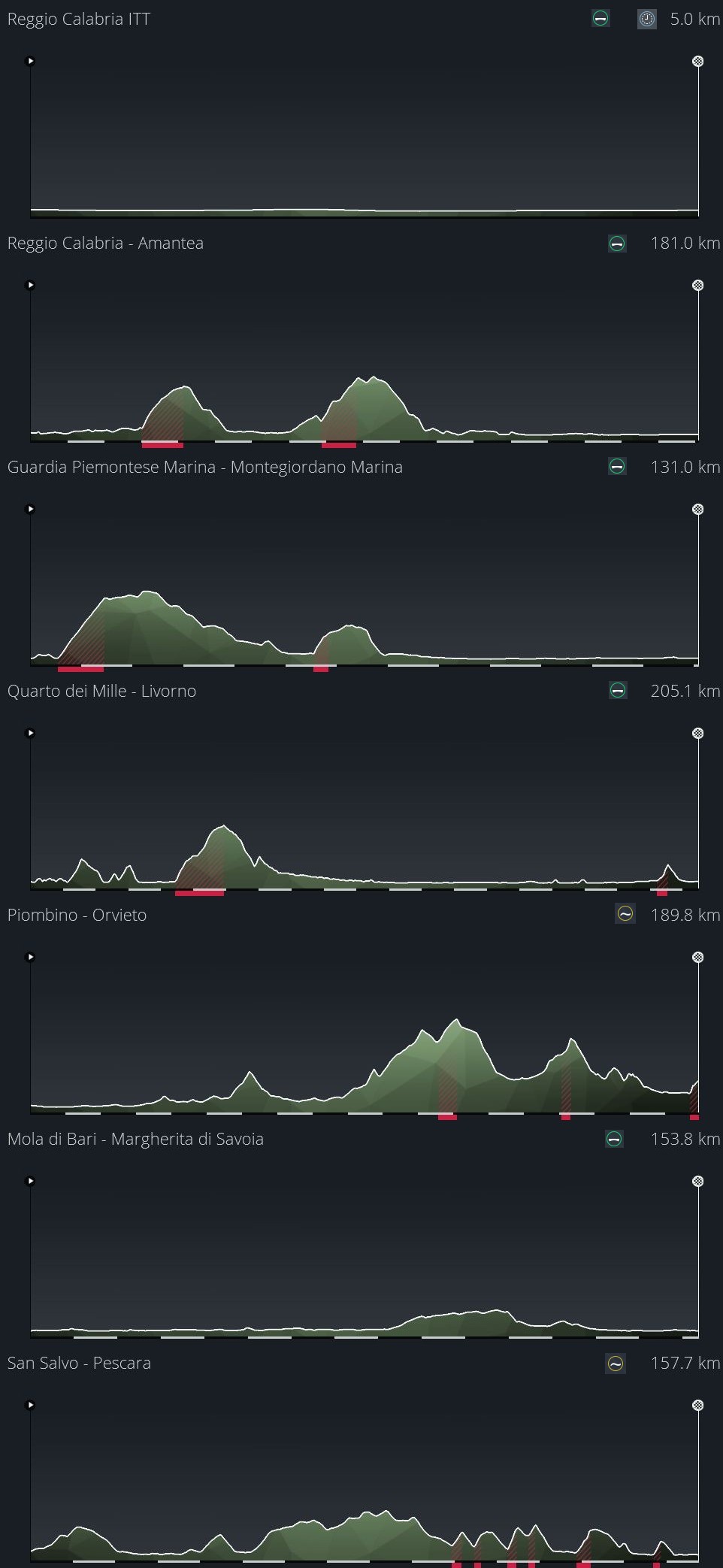
For the third year running the South of Italy hosts the Grande Partenza in what must soon mean a civil war, this time it's a 4km prologue in the wonderful city of Reggio Calabria, home of the Fatamorgana, toe of the boot of mainland Italy, and the 100th most populated city in Europe! The riders will be able to take a good look across the Strait of Messina - but it'll take a while to get there themselves. Instead the race quickly looks North with a flat stage up the coast to Amantea in a stage which will be one for the sprinters - but watch out for coastal winds!
That is completely copy-and-pasted from my 2023 route presentation, and that is just called efficiency because it's all still true. Well, except for four things: it's actually now only the fourth time in five years the race has started in the South, this time the Reggio Calabria prologue is 5km long, we're not going to Sicily at any point, and the fun population fact is almost certainly no longer true with the release of some new census data somewhere in Europe. Reggio Calabria is still beautiful though - take a look.
After the Grande Partenza the route does diverge from that of two years ago, though, with another coastal sprint stage on the way up the arch of the boot, finishing in the quiet commune of Montegiordano - a sure honour for the 2,000 strong village. Our first sign of any elevation to shout about on Stage 4, as after a plane transfer to the north-east of Italy we get another coastal stage from Liguria down to Tuscany, with our could-be sprint finish in Livorno rudely preceded by a short hill within the final 20km.
If the teams of the GC favourites have managed to make it through these coastal stages without any echelons or time losses, they are rewarded with the race's first trip inland to Orvieto, but will still have to be on their toes, with a lumpy day ending with a short hilltop finish - surely not enough for huge gaps or big attacks, but with sprint stages on either side we will surely see the first knives out of the race, a chance for bonus seconds and small time gaps, and perhaps someone to put their name forward first as someone to beat in Weeks Two and Three.
The race crosses the Apennines in the most boring way possible (by team bus) as - surprise! - we're not quite done with coastal sprint stages. Yes in lieu of the Giro's classic first week mountain stage on Etna or Blockhaus (though hold that thought...), we are recreating it in the aggregate like Brad Pitt and Jonah Hill in Moneyball, with the short TT, minor hills and lots and lots of potential for echelons. This time we're getting the Adriatic in on the action, with a short, very flat promenade along the Apulian coast.
The week ends with its toughest stage, heading north and remaining somewhat coastal as we continue to dance around the looming Apennines. While the first half out on San Salvo is nothing too concerning, an Ardennes-like profile hides in the back half, which should certainly see some kind of action, even if the last 20km only contains one hill (1.6km @ 7.5%) and is otherwise flat. A first breakaway stage, a hard-raced last two hours with GC consequences, a puncheur here to stage hunt - or maybe one for a hilly sprinter. Those still exist, right?
Week Two: I don't always climb, but when I do it's steep
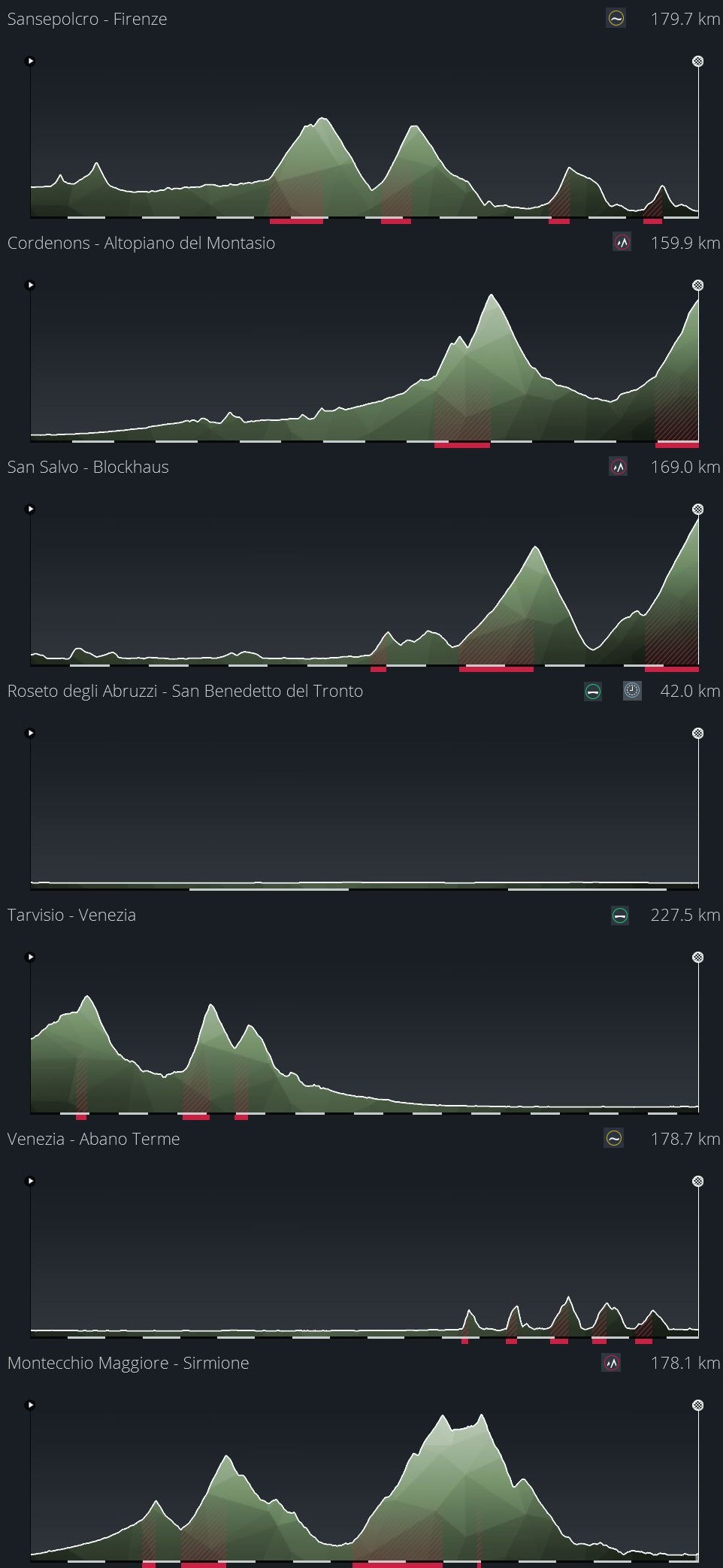
The second week finally sees the riders sent into the mountains, with two huge mountaintop finishes - one in the Alps and one in the Apennines - surrounded by the race's major chrono test and an eclectic mix of unclassifiable stages. First up, an antipasto before the storm to come, a transitional day on our way to lovely Firenze, with some of the race's longest climbs so far sure to be the scene of interesting KoM fights, while the decisive Fiesole hill (3km @ 5.7%) could see some GC action if anybody wants to shake the legs out before the next two days. Fun fact: in an alternate cycling universe, this was the setting of the 2013 World Championships Road Race.
Stage 9 starts in Cordenons, which Wikipedia tells me is being strangled by modern industrial development - relatable. This stage takes us to the Alps, finally removing the training wheels and puts the race's first two Cat.1 mountains on the table. First, cresting with 50km to go, is the Passo Cason di Lanza (13.8km @ 6.4%) - nothing to scoff at, but perhaps a truce could be called for the GC favourites, who will want to be at their best for the mountaintop finish at the Altopiano di Montasio, which as far as I can tell means something along the lines of "Mountainous Mountain", which it sure is - 12km at an average gradient of 7.3% will separate the initial wheat from the chaff and provide a first true arena for the GC battle.
A second true arena for the GC battle is up next, with the trip to one of the Giro's favourite haunts in Blockhaus. Another two-climb stage, each harder than yesterday's and each harder than the last. A second stage depart in San Salvo soon leads us over the Passo di Lanciano (10.3km @ 7.3%, with a 3km section averaging over 9% with slopes in excess of 14%), before a descent to the foot of the climb to Blockhaus, one of the toughest mountaintop finishes on the cycling calendar. 13.7km at an average of 8.4%, the last 10km average over 9% with max slopes of nearly 15%. While the third week has even more epic showdowns to come, it feels like anyone who wants to be wearing the pink jersey come race's end will need to be on their game on these two stages.
Did I say two? Sorry, I meant three. Without either a literal rest day or a metaphorical one in the form of a sprint stage, the riders then take on the race's second and final time trial - a pan-flat 42km ITT that takes us back out to the Adriatic coast. While the race's total ITT kilometres totalling under 50km isn't the end of the world for the less chrono-inclined stage racers, it will still provide key time gains and losses as the race hits its midpoint.
It might be easy to blow over the rest of Week Two after four days of GC fireworks, but they are both wonderfully weird and potentially consequential. First up is a coastal sprint stage, a new innovation to the race at this point which could really catch the riders off-guard. It finishes in beautiful Venice, which Wikipedia tells me is at real risk of sinking due to the looming threat of climate change. Once again, relatable.
Stage 13 is actually a flat stage that takes place on the coast which is interesting, however this one is not for the sprinters for in its back half the flat profile is punctured by five rather sharp looking climbs. Once again a stage which could have many outcomes. Stage 14 is similarly open, it contains two very hard climbs including the Monte Baldo - 21km at 7%. However, that peaks with around 60km still remaining on the day, with a plateau and long descent before a long flat finish into the quite beautiful resort town of Sirmione on the shores of Lake Garda. Not a bad place at all for a rest day - and boy will they need in before taking on Week Three.
As always, if anybody wants to help fund me taking a trip to Italy my DMs are open, I am going to combust and die if I don't get to go to the site of every photo included here.
Week Three: Oh, that's what we've been building up to
Wow. Zoncolan and Mortirolo aside, I'm not sure you can ask for many more iconic Giro d'Italia climbs to pack into the final week, even if it only contains three high mountain stages. Some of them are so nice, you know we have to do them twice as well.
The decisive final week starts with the race's Queen Stage, taking us from Tione di Trento to Sulden. If you don't recognise those towns by name, let me see if the roads that connect them ring a bell:
Campo Carlo Magno. Tonale. Gavia. Stelvio.
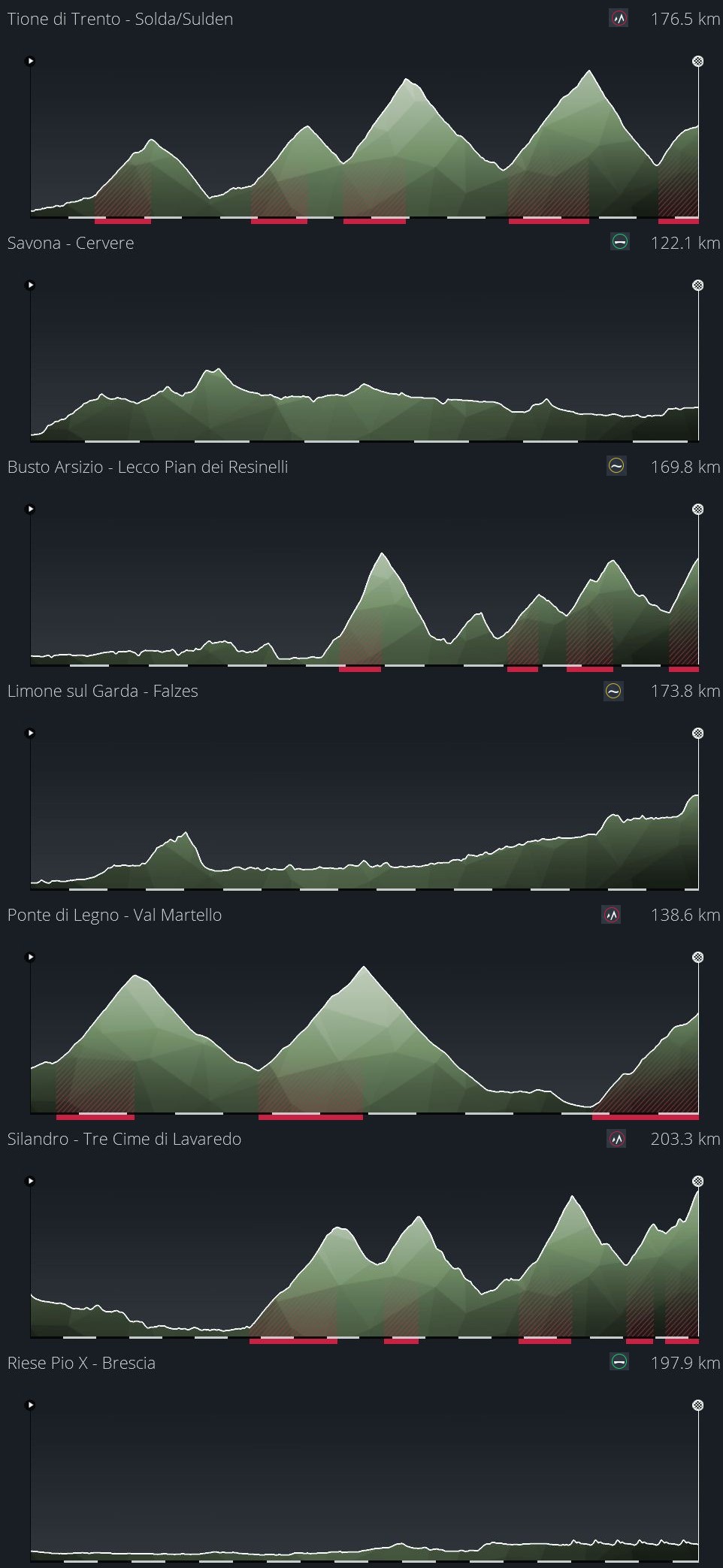
Oh yeah. This is that stage. The Cima Coppi at the Stelvio is obviously the centrepiece, but underestimate any of these climbs at your mortal peril (in terms of losing time in the race or your focus on the descent). The centrepiece Gavia-Stelvio combo are both taken from the easier southern sides (16.5km @ 8% and 21.7km @ 7.2%, the Cima Coppi) but that will feel like no mercy at all really. Even the finishing climb to Sulden, which may look tiny compared to these giants of Europe, is 8km at a deceptive 7%, with the first few kilometres regularly in double digit gradients. Not a marathon of pure length at 177km, but with 5670m of elevation gain over some of cycling's most fabled heights this is one of the stages you will still feel in every muscle fibre when you're telling your grandchildren about it in 50 years' time.
Stage 16 is mercifully flat, mercifully short, and, despite starting on the coast, mercifully headed inland. The Western Italian Alps don't quite get the love they might arguably deserve in this year's route, and so this stage is about as close as we'll come, while still maintaining a respectful distance.
Stage 17 might be easy to miss when your eyes dart from the Gavia and Stelvio down to Stages 19 and 20, but while I'd be surprised if the race was won here, it can certainly be lost. A medium mountain day in the heart of medium mountain country in Lombardy, with the second half of the stage viewing first from up close and then from high ground the beautiful Lake Como. The Valico di Valcava, a Cat.1 climb measuring 15.5km @ 7.2%, opens proceedings before a trio of mid-category climbs, with the Cat.2 ascent to Pian dei Resinelli a challenging 8km @ 7.6%. Certainly while it may not stand out this is sure to be a challenging and entertaining day, and once again oh my goodness this country is stunning.
Next is one of those transition stages the Giro loves to do: along valley roads, always and always ascending without ever truly breaking into a proper climb, just enough to scare off the sprinters, nowhere near enough to bother the GC teams or even the KoM hunters. Not a single categorised climb, but with slopes up to 10% on the road into the finish in Falzes, it's sure to provide some kind of action in the breakaway fight - perhaps the last chance for a true breakaway artist, because while the early attacks may win the days ahead, they will certainly still be some of the top climbers in the race to stand a chance.
If I didn't quite make it clear, I am a huge fan of the iconic climbs of Italy, and such a list must include the Gavia and Stelvio, and so you will not find me complaining that both are also contained, from the same side, in the 138km Stage 19. Cutting the (I believe much underappreciated) preamble of the Campo Carlo Magno and Tonale passes, we start in Ponte di Legno and immediately take on the mythic duo. However while they were the centrepiece of Stage 15, they really are here to serve as preamble (brutally hard and still potentially decisive preamble) to the finish at Val Martello, separated from them by 30km of valley roads. The climb is arrhythmic, with slopes up to 14% in the final kilometres, with the whole climb averaging 6.2% over a mammoth 22.4km, with 1462m of elevation.
The race's full masterstroke of pacing and buildup is confirmed with the climax on Stage 20, any thoughts of this as an "easier" Grand Tour route will probably not be taken kindly by the riders as they take on a classic Dolomites stage - while the Dolomites haven't had more than one stage in most recent routes, they have hosted the final mountain stage more often than not, taking on at least the Passo Giau. The Passo Giau-Tre Cime di Lavaredo combo is only repeated so often because it is so perfect. While the riders will be glad to hear we're not visiting the Pordoi or Fedaia beforehand, the stage is still plently hard enough while deferring glory to the beautiful but brutal Giau (9.8km @ 9.3%).
The climb to Tre Cime di Lavaredo is really three climbs: the Passo Tre Croci, the Misurina Col Sant Angelo, and finally the road up to Tre Cime itself. The first half over the Passo Tre Coci is some 8 km long, at 7.1% reaching up to 12%. Around 4km of gentle descent before some false flats and the short yet steep climb of the Misurina Col Sant Angelo, 2km @ 10.6%. A similarly short descent leads us to the finale: the climb to the picteuresque Tre Cime di Lavaredo. 4km at an average of 11.3% and with slopes up to 18% in the final 2km, this is a brutal finish to the Giro.
For the riders that survived all that, Stage 21 takes us to our finishing city of Brescia. A rather rude 197km, but perhaps that will give everyone time to really soak in their achievements (or lack thereof) before the remaining sprinters have their final say. After that the final jerseys and trophies awarded after what promises to be an amazing Giro d'Italia. While some might say the time trial kilometres aren't what they should be, it will still take a well-rounded stage racer, likely with a strong team in support, to take victory here. Climbs short and long, almost every stage containing some reason to stay alert, and as always some of cycling's most iconic and difficult climbs. See you in April!
7 Flat (5 Coastal)
5 Hilly (2 HTF)
2 Medium Mountain (1MTF)
5 Mountain (5MTF)
2 ITT (47km total)
This feels very different to the other GTs. Prologue + a very flat first week definitely gives chances for different groups of riders as the other ones. Interesting that there is not the one TT heavy route with the others already being on the short side but at least the TT kilometer look quite different from each other. Overall, i think i like it but its
Evonik-wise this feels most like a Foss route to me.
No TT heavy routes this year is interesting. Not a problem for me to be sure, but certainly widens/changes the pool of contenders.
This will be interesting to plan in terms of sprinting. Obviously this is the best GT for sprinters, but that could lead to an insane startlist. With the lottery though, that's not always a bad thing.
RIP Exxon Duke, David Veilleux, Double Feature, and Monster Energy
This maybe feels like a bit more of a classical GT. Definitely the most sprinter friendly that's for sure. It's another viable option for Pogi to go to. Given his stats he doesn't have a clear preference between hills or TTs.
Also I didn't mention this in the other route threads, but a big thank you to everyone for the nice writeups
Very much second what redordead wrote about a big thank you to you that have written the very nice writeups!
Big chapeau for making a proper GT start for the sprinters again. Curious to see if "everyone" thus lines up, or if someone decides to do different. Should make for a lot of fun guessing who is going where
Another GT that is properly backloaded on the most difficult mountain stages, which should make for a very nice follow, hoping the tension and excitement will build through the Giro.
Yeah, this really feels like the best fit for "classical" stage racers like Stüssi - but given that it's the only one of the GTs really fitting this rider type, I'm afraid he might struggle much more than last year...
The amount of sprint stages looks decent here, will be a tough choice where to send Groves in the end - to the race where all the sprinters will (likely) be, or to one of the less sprinter-friendly ones...
Nice to have a lot of those iconic Giro climbs in this race, even more than once for some - even though I'm sure adding Mortirolo, Zoncolan and Finestre also would have worked somehow to make this one truly insane
Looking forward to some great fights for the GC here!