The last GT to publish the route. The biggest race on the calendar maybe. The Tour de France, the dream by every young cyclist.
The riders on the winner list are impressive stage racers, allrounders and are some of the very best. Seeing the most recent ones, Andy Schleck, Madrazo, Pluchkin, Spilak you get a great feeling about the quality of the GC winner.
Taaramae twice came second in past 2 years and now heading towards a new team. Will be interesting to see if he can finally get on top of the podium as also young US rider Dombrowski, who had his very final breakthrough last year and surely comes back stronger in future.
But let`s start with the 2017 edition of the race.
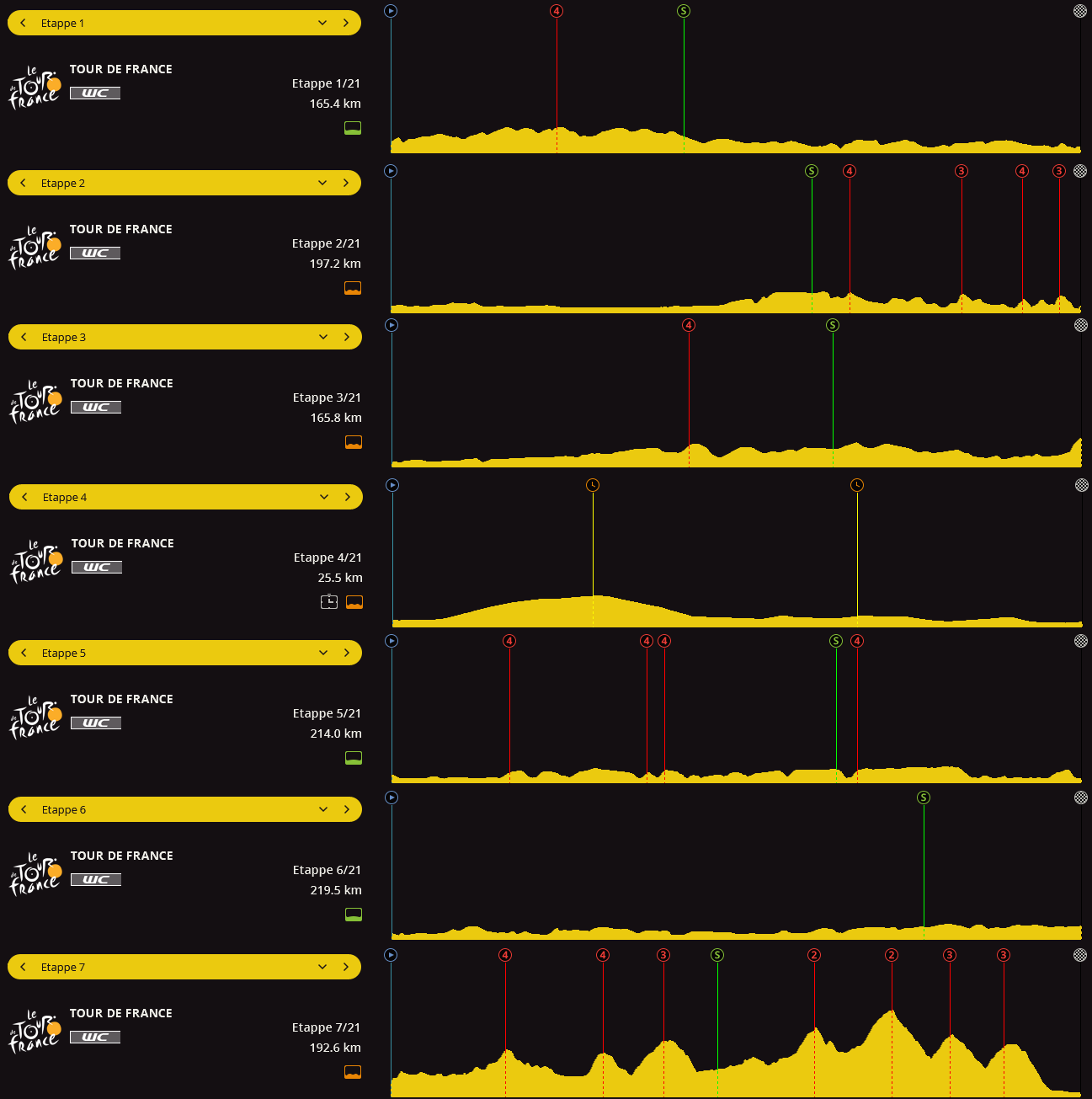
Week 1: Pretty calm but no time to relax
The first week starts without a lot of climbing. Grand Depart is in the Bretagne around the area of Carhaix and we start with a day for the sprinters! So watch out for the fast men to go for the Maillot Jaune on this day.
That said, only a good hill sprinter then will be able to defend it as the upcoming two stages are not as flat as most sprinters would like. Some hill and coast racing on those two days with the highlight being the hill top finish on the Muúr de Bretagne on day 3.
The fourth day somewhat remains on hilly terrain, but this time it`s not as much for the puncheurs. It`s for the time trialist but as the Tour de France is for allrounders, the time trialists need to be able to climb a bit and hence also the GT favourites might already like the look of this.
The next two stages are yet again for the sprinters and in case one of them was able to go over the hills and time trial a bit, he might have a chance for the Maillot Jaune again but this is actually very difficult to acchieve.
The last day in the first week definitely will see the puncheurs and stage racers open the bigger gap to the rest as lots of longer hills on this stage.
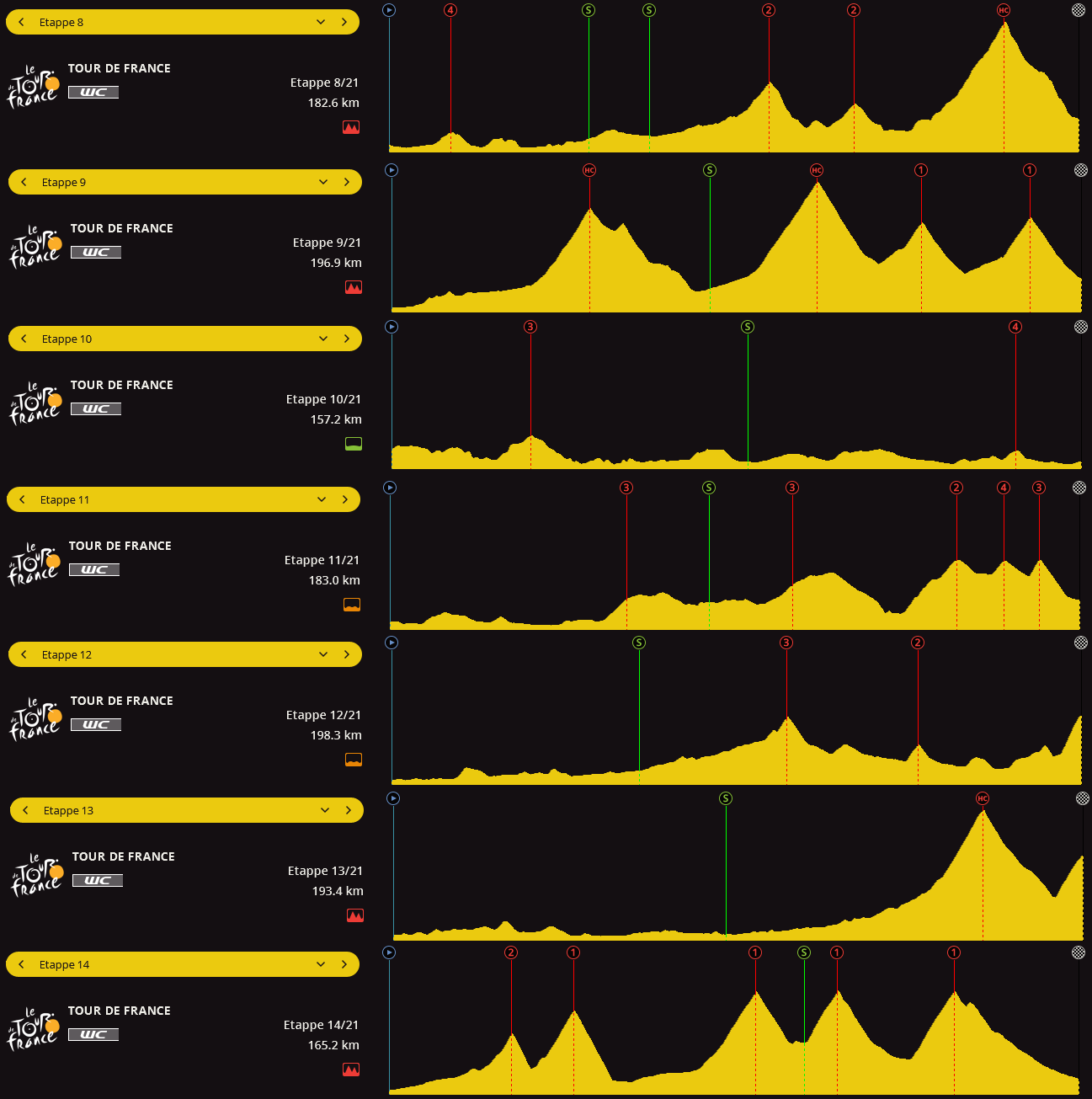
Week 2: Mountains yes, but sprint skills needed
4 mountain stages in the 2nd week and 2 hill stages. Not a lot of fun for the sprinters, which only get a chance on the 10th day.
And also the top climbers might have liked more top finishes as often you need to go down the long descent towards the finish and hence going uphill can`t be your only skill. A bit of descending and sprinter skills come in handy.
The first mountains this year will the the Pyrenees around the area of Pau as so often in the Tour.
The mountain top finish will be placed on Ax3 Domaines.
Week 3: Chances for the climbers and a late ITT
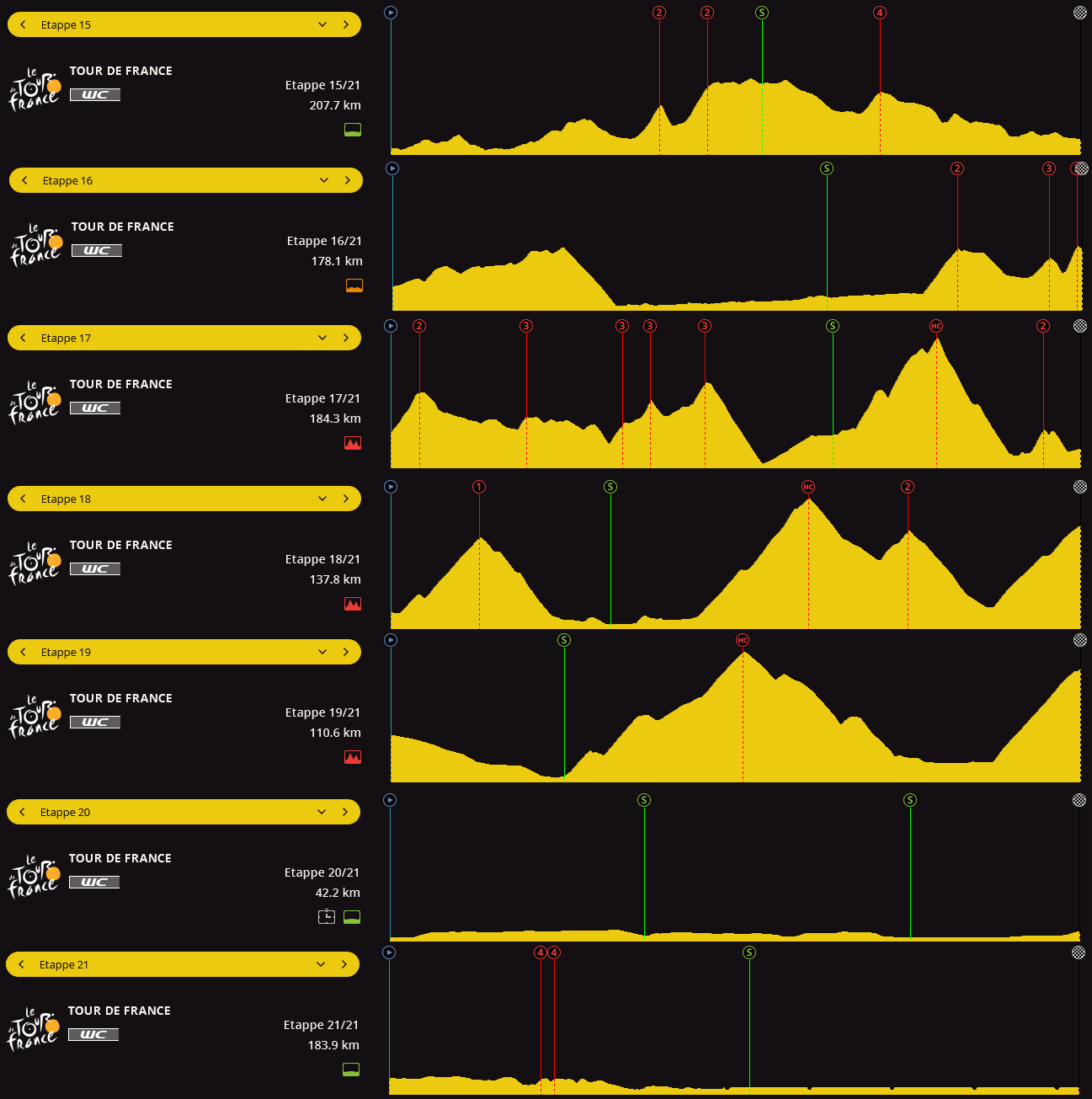
While the sprinters will have one of their last chances on day 15, the Alps slowly start and probably are the more difficult mountains this year.
Mende, Saint-Jean-de-Maurienne, La Toussuire and the last mountain stage finishing on top of Alpe d'Huez should really deliver a thrilling finale.
But if you think, the decision comes after the last mountains, you are wrong. 42km of pretty flat time trialing on the penultimate day of the Tour de France and suddenly the outcome can be totally different again. Hence pressure is higher on good climbers when better allrounders are still close.
Last day the regular Champs Elysees celebration parade with the final chance for the sprinters.
And I like it a lot, especially the balanced look of it. Not brutal in terms of mountains, neither in terms of time trialling, but a lot of everything, also the hills.
Kind of tailor made for Spilak and Gesink looking at the overall win, but even riders like Ponzi and Bakelants could fancy their chances for a surprisingly good GC here.
Another weird race with Peyresourde, Portet-d' Aspet and Croix de Fer being climbed twice. Also, they climb Glandon on stage 18. (which is only 3 kms away from Croix de Fer)
Stage 7 is a good stage. And 67 km of ITT is a good thing but should have been more with 7 mountain stages.
And many known climbs which I don't like. Alpe, Peyresourde and Tourmalet again, for example.
I liked the 2015 edition a lot more (where there were Bisanne, Les Deux Alpes, Gavarnie, the descent finishes to Pragelato and Les Estables)
Edited by Forever the Best on 25-08-2017 12:57
The user formerly known as 'The Schleck Fan' Gracias Alberto.
ember wrote:
Wow, very, very, VERY interesting TdF route!
And I like it a lot, especially the balanced look of it. Not brutal in terms of mountains, neither in terms of time trialling, but a lot of everything, also the hills.
Kind of tailor made for Spilak and Gesink looking at the overall win, but even riders like Ponzi and Bakelants could fancy their chances for a surprisingly good GC here.
Indeed. This looks very interesting. Also for riders like Koretzky and especially Arnaud Demare must have candlelights in his eyes after seeing this - Especially week 1.
If Spilak had more than 34 racedays this would have been a given, but getting 3rd here would be devastating. Scoring a similar amount of points as his last season TdF would kill the team. Simple as that.
But it is definately worth a thought. I'm considering making my french legion kick ass though:
Another weird race with Peyresourde, Portet-d' Aspet and Croix de Fer being climbed twice. Also, they climb Glandon on stage 18. (which is only 3 kms away from Croix de Fer)
And many known climbs which I don't like. Alpe, Peyresourde and Tourmalet again, for example.
The goal when we designed the route(s) was finding stages that fitted a certain look. As you can see, we weren't concerned about mountain passes repeating when it wasn't that noticeable - I mean it's not like we were anticipating someone just looking at this stage by stage and pinpointing exactly what were the climbs in each mountain stage With that being said, mountain passes being climbed twice in different stages happens in real life too, see e.g. Tour 2015 and La Croix de Fer, although it of course doesn't happen to the extent you see here.
Stage 7 is a good stage. And 67 km of ITT is a good thing but should have been more with 7 mountain stages.
No GT was supposed to be that heavily time trialists-oriented. Climbs wise, this has to be the 'easiest' Grand Tour of this year's MG batch, but it's also the one with the most ITT kilometres which means that it aimed to be decently TT favourable nonetheless. Furthermore, with the profile of the present hilly stages and their amount, it also aims to please a good amount of puncheurs like last year's Vuelta did.
I liked the 2015 edition a lot more (where there were Bisanne, Les Deux Alpes, Gavarnie, the descent finishes to Pragelato and Les Estables)
The 2015 edition had 40 ITT kilometres and as many mountain stages - with a stage 20 that was a lot harder than any other stage in this edition. I'd say it's clear which kind of riders it was mostly aimed to. Those same kinds of riders have now either Giro or Vuelta to shine.
Another weird race with Peyresourde, Portet-d' Aspet and Croix de Fer being climbed twice. Also, they climb Glandon on stage 18. (which is only 3 kms away from Croix de Fer)
And many known climbs which I don't like. Alpe, Peyresourde and Tourmalet again, for example.
The goal when we designed the route(s) was finding stages that fitted a certain look. As you can see, we weren't concerned about mountain passes repeating when it wasn't that noticeable - I mean it's not like we were anticipating someone just looking at this stage by stage and pinpointing exactly what were the climbs in each mountain stage With that being said, mountain passes being climbed twice in different stages happens in real life too, see e.g. Tour 2015 and La Croix de Fer, although it of course doesn't happen to the extent you see here.
Stage 7 is a good stage. And 67 km of ITT is a good thing but should have been more with 7 mountain stages.
No GT was supposed to be that heavily time trialists-oriented. Climbs wise, this has to be the 'easiest' Grand Tour of this year's MG batch, but it's also the one with the most ITT kilometres which means that it aimed to be decently TT favourable nonetheless. Furthermore, with the profile of the present hilly stages and their amount, it also aims to please a good amount of puncheurs like last year's Vuelta did.
I liked the 2015 edition a lot more (where there were Bisanne, Les Deux Alpes, Gavarnie, the descent finishes to Pragelato and Les Estables)
The 2015 edition had 40 ITT kilometres and as many mountain stages - with a stage 20 that was a lot harder than any other stage in this edition. I'd say it's clear which kind of riders it was mostly aimed to. Those same kinds of riders have now either Giro or Vuelta to shine.
Yeah, all good points.
And those 3 mtn stages are just copied from that TDF. Since it is PCM, I'd be interested to see how the Glandon-Montvernier combo will work out. (It can be a great stage.)
And I said 2015 was better because I saw many mountain stage finishes that the TDF either never used or haven't used for years. And since it is PCM, the climbers attack even when they are in a good position so that the TT kms aren't as needed as IRL to make a good race. (And there is also no Sky train, making the mtn stages much more exciting most of the time)
Edited by Forever the Best on 25-08-2017 13:42
The user formerly known as 'The Schleck Fan' Gracias Alberto.















 With that being said, mountain passes being climbed twice in different stages happens in real life too, see e.g. Tour 2015 and La Croix de Fer, although it of course doesn't happen to the extent you see here.